google.com, pub-7005347536103574, DIRECT, f08c47fec0942fa0 Taxexcel
Breaking News
Loading...
Share It

Wednesday, 24 May 2023


 Which is better between the New and Old Tax Regime for F.Y.2023-24 and A.Y.2024-25? Now is the

 time for many participants; Salaried individuals, in particular, have to choose between opting for the

 New Tax Regime or continuing with the Old Tax Regime. Through this article, the author wants to help

 them in their decision-making process.


There is no change in the slab rates for the old tax regime. No tax for income of 0 to 2.5 Lakh, a tax rate of 5% for income of 2.5 to 5 Lakh, a tax rate of 20% for income of 5 to 10 Lakh, a tax rate of tax for income of more than 10 Lakh is 30%. 

Which is better between the New and Old Tax Regime for F.Y.2023-24,Download Auto Calculate Income Tax Calculator All in One for the A.Y.2024-25

For Sr. Citizens (from 60 years and above) – Rs. 3 lacks tax-free and income for super seniors (80 years+) is Rs. 5 Lakh tax-free.


The new slab for the new tax regime notified by Finance Act 2023 is 0 to 3 Lakhs income no tax 3 to 6 Lakh income tax rate 5% 6 to 9 Lakh income tax 10% Income 9 to 12 Lakh tax rate 15%, the Income tax rate of 12-15 lakhs is 20%, the tax rate is 30% for income above 15 lakhs.


The standard deduction for salaried taxpayers. 50,000 continues for the Old Fiscal regime and the same has been introduced in the New Fiscal regime.


The new tax regime becomes the Default regime and the Taxpayer has to select the Old Tax regime if he wants to continue with the Old Rates.


Exemptions under the new tax regime are Rs. 7 Lakhs. In the old tax regime, it was Rs. 5 Lakhs. The new tax regime also has a Concept of Marginal Relief (Dependent on Rebate).


If the taxpayer opts for the new tax regime, Relocation Allowance (LTA), House Rent Subsidy (HRA), Child Education Subsidy, Professional Tax Deduction, Home Loan Interest, Investment Income, etc. are mentioned. allowed. However, it should be noted that under the new loan regime, the deduction for interest paid on home loans taken for home ownership is not available.


In the new tax regime, taxpayers can be entitled to claim the benefit of employer's contributions to the National Pension System (NPS) account U/s 80CCD(2) as per the Income Tax Act. This deduction is restricted to the employer's contribution to NPS up to a limit of 10% of salary (Basic + DA).


A taxpayer opting for a new tax period has to give up various exemptions under sections 80C, 80D, 80G, 80TTA/80TTB, and 80E. However, voluntary pension exemptions, gratuity exemptions, and holiday pay exemptions are available under the new tax regime.

Download Automated Income Tax Preparation Excel-Based SoftwareAll in One for all salaried persons for the F.Y.2023-24 and A.Y.2024-25


Which is better between the New and Old Tax Regime for F.Y.2023-24

Form 10E

Feature of this Excel Utility:-


1) This Excel utility prepares and calculates your income tax as per the New Section 115 BAC (New and Old Tax Regime)


2) This Excel Utility has an option where you can choose your option as a New or Old Tax Regime


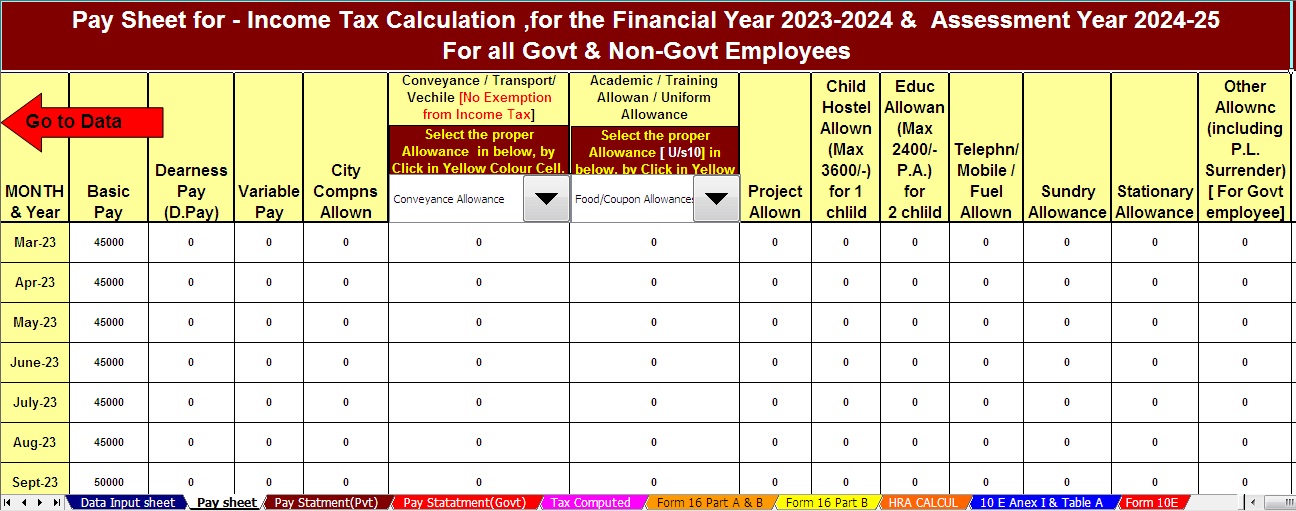
3) This Excel Utility has a unique Salary Structure for Government and Non-Government Employees Salary Structure.


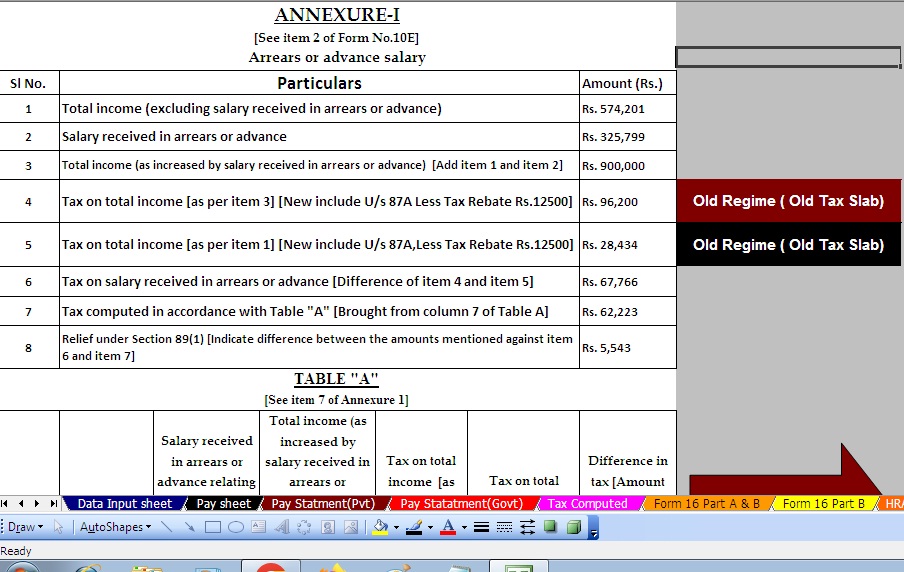
4) Automated Income Tax Arrears Relief Calculator U/s 89(1) with Form 10E from the F.Y.2000-01 to F.Y.2023-24 (Update Version)


5) Automated Income Tax Revised Form 16 Part A&B for the F.Y.2023-24


6) Automated Income Tax Revised Form 16 Part B for the F.Y.2023-24

Tuesday, 23 May 2023


 New income tax regime disallowed deductions| Below is a list of key tax deductions that are claimed

 under the current tax regime but not under the new income tax regime:

• Exemptions under Section VI-A, ie Section 80C; 80CCC; employee contribution 80CCD; 80D; 80DD; 80DDB; 80E; except under 80EEA, 80CCD(2) and 80JJAA;

• Interest on home loans (Section 24 b);

• Waiver of travel concession;

• Housing rent subsidy;

• Subsidy for the income of minors;

• Standard discount;

Receiving an allowance for representation;

• Exemption from SEZ unit;

• Exemptions under sections 32AD, 33AB, 33ABA;

Deductions for donations or research expenses;

• Exemptions under sections 35AD and 35CCC;

• Reduction of family pension.


Exemptions allowed by the new income tax regime


Although many tax deductions and exemptions are not claimed under the new tax regime, the following deductions are allowed under the existing rules:


• Employer's contribution to pension account notified under section 80CCD(2) of the Income Tax Act. However, this deduction cannot exceed 10% of the employee's previous year's salary.

• Up to 30% of employee fringe benefits under section 80JJAA of the Income Tax Act.

• Transport Subsidy is given to disabled workers (Drivers) to move between their place of residence and place of work.

Transport subsidy is provided for carrying out official functions.

• Any allowance is given to cover the cost of the tour/travel.

• Per diem allowance is given to cover the normal allowance when the employee has to work at a place other than his usual place of work.


Which regime you choose for a better result


While the new regime comes with flat income tax rates, it also removes many tax exemptions. For example, you cannot claim certain basic tax deductions available under Section VI-A of the Income Tax Act. In addition, you should give up the old exemption regime, under the old tax regime, any salaried person or pensioner can avail it, regardless of their annual income.

So the answer to which one is better depends on two factors – your annual income and the deductions and allowances you claim under the old tax regime. If your total tax amount is lower under the old (existing) tax regime, file ITR at old tax rates.

Download Automated Income Tax Preparation Excel-Based Software All in One for the Government & Non-Government (Private) Employees for the F.Y.2023-24 and A.Y.2024-25


New income tax regime disallowed deductions

Form 10E

Feature of this Excel Utility:-


1) This Excel utility prepares and calculates your income tax as per the New Section 115 BAC (New and Old Tax Regime)


2) This Excel Utility has an option where you can choose your option as a New or Old Tax Regime


3) This Excel Utility has a unique Salary Structure for Government and Non-Government Employees Salary Structure.


4) Automated Income Tax Arrears Relief Calculator U/s 89(1) with Form 10E from the F.Y.2000-01 to F.Y.2023-24 (Update Version)


5) Automated Income Tax Revised Form 16 Part A&B for the F.Y.2023-24


6) Automated Income Tax Revised Form 16 Part B for the F.Y.2023-24
Monday, 22 May 2023


 Income Tax Return: If you file your income tax return (ITR File) every year, you need to read this

 update. The ITR-2 offline form has been issued by the Indian Income Tax Department for filing

 income tax returns for the tax year 2022-23 (A.Y 2023-24).


Income Tax Return for A.Y.2023-24

Last month, CBDT notified ITR-1 and ITR-4 forms. We inform you that ITR online forms are not issued by Income Tax. Currently, only Excel support has been released for ITR-1, ITR-2, and ITR-4 

In this case, if a person wants to declare ITR immediately, he has to download the tool on the Income Tax e-declaration website. After filling the utility form with information related to income and tax allowances, it needs to be uploaded to the e-Income Tax platform. For example, no changes have been made to the ITR form this year. 

Information about virtual currency should also be provided 

An important change in the ITR form is that you will have to provide information about virtual currency and digital assets. While submitting your ITR form offline or online, remember to verify it. If the ITR is not approved by the taxpayer, it will not be processed by Income Tax. 

Who can complete ITR-2? 

If your annual income is Rs. 50 Lakh or more, you need to file an ITR-2 form. Accordingly, more than one residential property, capital gains or losses on investments, dividend income of more than 10 Lakh, and income from agriculture must be disclosed. Apart from this, if you earn PF interest, this form will also be filled out.

Monday, 24 April 2023

 You cannot claim tax reduction for these below-given deductions under the new regime for the financial

 the year 2023-24| New tax regime vs. old tax regime: two people on the same salary may have different

 amounts of deductions, and therefore their tax regime may be different


Choosing the right tax regime at the beginning of the financial year is crucial in considering tax planning for self-employed taxpayers. An IT circular issued earlier this month said companies should consult employees about their preferred tax regime for the current financial year.


Since employers have to withhold TDS from paying wages, and if employees do not disclose their preferred tax regime, this can lead to higher TDS on wage income, which will affect their take-home pay.

You may also like- Download and Prepare at a time 50 Employees Form 16 Part B for the Financial Year 2022-23 and Assessment Year 2023-24

The choice between the new and the old tax regime depends essentially on the individual's pay scale and investment and other decisions that may be subject to an exemption. He added that two people on the same salary may have different amounts of deductions, and therefore their choice of tax regime may be different.


However, he says the main factors to consider before choosing a new or old tax regime focus on qualifying deductions.


If you opt for the new tax regime, you are not entitled to the following 7 key deductions:

1. Section 80C Investment in PPF, NSC, ULIP, LIC, Old Age Scheme, etc., and payment of tuition fees, registration fee on the purchase of a new house, etc., and depreciation of home loan, the total deductible amount is Rs 1, 5 lacks.

You may also like- Download and Prepare at a time 100 Employees Form 16 Part B for the Financial Year 2022-23 and Assessment Year 2023-24


2. Section 80D Payment of Health Insurance Premiums: A person can claim a deduction of up to Rs.25,000 for insurance of self, spouse, and dependent children. A further deduction of Rs 25,000 is allowed for parents under 60 years of age. Also, you can claim up to Rs. 75,000 for you and your parents above 60 years of age.


3. Section 80E Interest on student loans: A person may demand payments for interest on student loans. For higher education loans, a deduction on the interest on the loan is allowed with no upper limit on the deduction.


4. Section 80TTA and 80TTB Interest from Savings Bank Account and Fixed Deposits: Under Section 80TTA, a person can claim a maximum deduction of Rs.10,000 for savings account interest with any bank, post, or cooperative society. Under Section 80TTB, seniors can claim a maximum deduction of Rs 50,000 for savings account interest with any bank, post office or cooperative society and interest on fixed deposits.

You may also like- Download and Prepare at a time 50 Employees Form 16 Part A&B for the Financial Year 2022-23 and Assessment Year 2023-24


5. Section 10(5) LTA: The amount deducted under Article 10(5) in respect of the amount of travel expenses or assistance received by a person or from his employer or former employer for himself and his family.


6. Section 10(13A) HRA: An employer may provide a high rent allowance (HRA) to its employees to help them meet their rent. Such gain is taxable for the employee. However, Section 10(13A) of the Income Tax Act provides for the deduction of HRA within specific parameters.


7. Section 24b owner-occupied property interest: Subject to Article 24b, interest paid on the owner-occupied property is deductible from gross income. The landlord alone is allowed to deduct the interest paid up to the total amount of Rs 2 lakh.

Download Automated Income Tax Preparation Excel-Based Software All in One for the Government & Non-Government (Private) Employees for the F.Y.2023-24 and A.Y.2024-25


You cannot claim tax reduction for these below given deductions under the new regime

You cannot claim tax reduction for these below given deductions under the new regime

You cannot claim tax reduction for these below given deductions under the new regime

Income Tax Form 10E

Feature of this Excel Utility:-


1) This Excel utility prepares and calculates your income tax as per the New Section 115 BAC (New and Old Tax Regime)


2) This Excel Utility has an option where you can choose your option as a New or Old Tax Regime


3) This Excel Utility has a unique Salary Structure for Government and Non-Government Employees Salary Structure.


4) Automated Income Tax Arrears Relief Calculator U/s 89(1) with Form 10E from the F.Y.2000-01 to F.Y.2023-24 (Update Version)


5) Automated Income Tax Revised Form 16 Part A&B for the F.Y.2023-24


6) Automated Income Tax Revised Form 16 Part B for the F.Y.2023-24

Friday, 21 April 2023

  Fixed deposit rate – If you are planning to take a fixed deposit ie. FD, you need to know a few things

 before you invest any money. If you invest in the smart investor's way, you will not only earn more

 interest, but you will also get many other benefits.


Due to features such as favorable interest rates, low risk of money sinking, and withdrawals whenever you want, fixed deposit is a preferred investment tool by investors. If you invest in FD wisely by understanding the banking rules properly, then not only will you get more returns (FD return) but the chance of sinking your money will also be zero. Even if the bank fails, you will get your cake back. Some savvy investors use these three strategies to enjoy more interest and liquidity than others.


Not that the bank has given them anything separate. They just change the way you invest in FD. They take due advantage of the rules made by the Reserve Bank and make risk-free investments. If you also adopt these three smart methods while investing your money in FD, you will also reap many benefits.

 You may also like- The Automatic Calculate Income Tax Arrears Relief Calculator with Form 10E from the F.Y. 2000-2001 to F.Y.2023-24 

Don't take FD of any amount from any bank

Don't take FD of any amount from any bank

Form 10 E Annexture I


Don’t invest any money in FD


You don’t have to invest all your money in just one FD. Divide the amount you want to invest in the FD. Instead of investing all your money in a fixed amount that lasts the same amount of time, divide the money into three tranches. Invest your money in a variety of short-term deposits.

Do FD in different banks


There are also differences in banks’ FD interest rates. Smaller banks tend to pay more interest than bigger banks. So instead of getting FD from one bank, you should get FD from different banks. You can get an FD for a small fee from a small bank. One advantage of having an FD with multiple banks is that if one bank fails, you don’t lose all your money.


Guaranteed money of Rupees Five lakh is available on bank deposits. This guarantee is provided by the Deposit and Credit Guarantee Corporation (DICGC), a subsidiary of RBI. You will get back only Rupees Five Lakh. If you have accounts in several branches of the same bank and the amount deposited in them is more than five lakhs, even then only five lakhs of rupees will be refunded to you. So you can secure your money by having FD in different banks.


Focus on the duration


You don’t invest your money in FD. FD accounts were also opened in several banks. But if you make it by mistake, you would not achieve the full benefit. Especially interest and liquidity. This does not diversify the FD holding. You have to invest your money in FD of different terms with different banks. If you invest in 1-year, 3-year, and 5-year fixed-term deposits, you will earn more interest and the money will also come to you at regular intervals.


There are differences in interest rates for FDs of different terms. By setting up an FD like this, you will need your money in three ways and it will be more than the interest you will earn by investing in the FD for the same period. If we invest in multi-holding FDs, then one or the other of our FDs will continue to mature at shorter intervals.


Because of this, we will not face any shortage of funds. Also, if we need money suddenly, we can withdraw from an FD in between. Because our entire fund is invested in different trenches, the loss from early withdrawal is minimal.

Download Automatic Calculate Income Tax Preparation Software All in One in Excel for the Non-Government Employees for the F.Y.2023-24 and A.Y.2024-25 as per Budget 2023

Don't take FD of any amount from any bank

Don't take FD of any amount from any bank


Thursday, 20 April 2023

  New tax regime: Update! Income tax provided excellent information on the TDS of employees. Note

 that the new tax section is the default, so if you don't want to choose the new tax section and want to

 keep the old one, you can choose the old tax section. Let's find out all about it.

What new or old tax regime do you want to choose for taxation, now your company will ask you this

 question. In this regard, the Income Tax Department has recently issued a notification.

The Income Tax Department says that now a company cannot deduct TDS without consulting the

 employee. To do this, you must obtain the permission of the employee. The TDS will be deducted

 according to the employee's choice of tax regime. And based on that you will be paid.

You may also like- Automatic Income Tax Form 16 Part B for the Financial Year 2022-23 and Assessment Year 2023-24 [This Excel Utility Can Prepare at a Time 50 Employees Form 16 Part B]

New tax regime


Note that the new tax section is the default, so if you don't want to choose the new tax section and want

 to keep the old one, you can choose the old tax section.

If no regime is selected, then

However, if the employee does not want to opt for any regime, then according to the new tax regime

 launched in the 2023-24 corporate budget, the employee's TDS will be waived. However, wage earners

 have many options for higher deductions and tax breaks. They can get a TDS exemption under any tax

 slab. For this reason, the company cannot deduct the TDS of any employee without consulting it.

The tax slab and the tax rate of the new tax regime

0% tax on profit of Rs 0-3 lakh

5% tax on Rs 3-6 lakh

10% tax on Rs 6-9 lakh per year

15% tax on profit of Rs 9-12 lakh

20% tax on annual profit of 12-15 lakhs

30% tax on income of Rs 15 lakh or more

Tax Slab and Tax Rate of the Old Tax Regime

No tax will be paid on profits up to 2.5 lakhs

5% income tax from 2.5 sin to 5 lakh

20% tax on income between Rs 5 lakh and Rs 10 lakh

The tax of 30% on the annual income of 10 missings or more

Download Auto Calculate Income Tax Preparation Excel-Based Software All in One for the Government and Non-Government Employees for the Financial Year 2023-24 and Assessment Year 2024-25

New tax regime

Tax Computed Sheet
New tax regime


Wednesday, 19 April 2023

  Everything you need to know about Form 16: TDS Certificate for Salary | Employers issue Form 16

 TDS certificates to their employees. It is proof of the deduction of tax at source from the worker's

 salary. Furthermore, the genesis of this form can be seen in section203 of the Income Tax Act 1961 as

 TDS. It is a part of the income under the "salary" heading.


When is Form 16 issued?


Form 16 is issued on the employer's tax deduction from the employee's salary. The tax deducted by the employer must be deposited into the government account.

Download and Prepare at a time 100 Employees Auto Calculateand Automatic Excel Based Form 16 Part B for the Financial Year 2022-23 and Assessment Year 2023-24

Everything you need to know about Form 16 - TDS Certificate for Salary
Relevance of Form 16


Proof of tax withheld at source by the employer is essential. This certificate details a summary of the employee's salary, allowances, and other amounts paid or credited to the employee and the TDS applicable to the employee. This form is issued annually in accordance with the provisions of the Law and can be used to file Income Tax Returns.


Basics of Form 16:


a) Form 16 is a TDS certificate for salary

b) Is issued to employees with a salary higher than Rs. 2.5 lacs in a fiscal year.

c) If your income is below the exemption threshold of Rs. 2.5 lacs, then there will be no issue of Form 16.

d) If the employee has worked with more than one employer during the applicable tax year, two forms will be issued for the respective employees.

e) Finally, template 16 also contains the details of the employer's TDS deduction and other details of the income that the worker provides to the employer.

Download and Prepare at a time 50 Employees Auto Calculate and Automatic Excel Based Form 16 Part B for the Financial Year 2022-23 and Assessment Year 2023-24


Everything you need to know about Form 16 - TDS Certificate for Salary

For the current fiscal year 2022-2023, and assessment year 2023-2024, the employee needs the following details to file their ITR:


1. Salary

2. Exempt Assignments Under Section 10

3. Total amount of salary received from current employer (=1 – 2)

4. Section 16 deductions. Includes standard deduction, entertainment allowance, and employment tax.

5. The Total deductions of U/s16.

6. Income attributed under the heading 'Remuneration' (= 1+ 3- 5)

7. Any other employee-reported income (this includes employee-reported income or loss of residential property offered for TDS and income under Other sources offered for TDS)

8. Other income declared by the employee

9. Total Gross Revenue (= 6 + 8)

10. Breakdown of Chapter VI-A Deductions

11. Addition of Deductions in accordance with Chapter VI-A (Gross Amount and Deductible)

12. Total income (= 9 – 11)

13. Tax payable or refund due

Download and Prepare at a time 100 Employees Auto Calculate and Automatic Excel Based Form 16 Part A&B for the Financial Year 2022-23 and Assessment Year 2023-24


Everything you need to know about Form 16 - TDS Certificate for Salary

Parts of Form 16


PART A: The Information in Part A are:

1. Employer's name and address

2. Employee name and address

3. TAN and PAN employer

4. PAN employee

5. Summary of the amount paid/credited and withholding tax in relation to the worker


PART B: Part B is the annex to Part A and the components of Part B are:


1. Wage breakdown

2. Details of Exempt Appropriations Pursuant to Section 10 Specific Appropriations Pursuant to Chapter VI-A:

The list of deductions is:

Download and Prepare at a time 50 Employees Auto Calculate and Automatic Excel Based Form 16 Part A&B for the Financial Year 2022-23 and Assessment Year 2023-24


    1) The deduction for life insurance premium paid, PPF contribution, etc., of article 80.ºC


    2) The deduction for contribution to pension funds under section 80 CCC


    3) The deduction of the employee's contribution to the pension scheme provided for in no. 80CCD(1)


    4) The taxable person's self-contribution deduction for the pension scheme notified under Section 80(1B) CCD


    5) The deduction for an employer's contribution to a pension plan under section 80CCD(2)


    6) The deduction of health insurance premiums paid under section 80D


    7) The deduction for interest paid on loans taken out for higher education under section 80E


   8) A deduction for interest payments made on loans taken out for home ownership under Section 80EE


    9) The deduction available only to individuals for interest payments made on loans taken out for the acquisition of a residential property for the first time under Section 80EE


    10) The deduction for donations made under Section 80G


    11) The deduction for rent paid for the house is applicable only to those who are self-employed or for whom the HRA is not part of the salary in accordance with Section 80GG


    12(The deduction for interest income on savings accounts under section 80TTA


    13) Deduction for Interest Received on Senior Citizens' Deposits Pursuant to Section 80TTB


    14) Deductions for a resident individual taxpayer with a disability under Section 80U


4. Relief under Section 89(1)

Download and Prepare One by One Auto Calculate and Automatic Excel Based Form 16 Part A&B and Part B for the Financial Year 2022-23 and Assessment Year 2023-24

Income Tax Form 16 Part A&B and Part B


google.com, pub-7005347536103574, DIRECT, f08c47fec0942fa0