google.com, pub-7005347536103574, DIRECT, f08c47fec0942fa0 Taxexcel
Breaking News
Loading...
Share It

Tuesday, 14 March 2023

  Union Budget 2023| Now a person with an income of Rs 15,000 will have to pay only Rs 1.5 or 10 %

 of their income.


The Union Budget 2023-24, introduced by Finance Minister Nirmala Sitharaman on February 1, proposed to increase the tax deduction to Rs 7 lakh from the current Rs 5 lakh as part of a package of changes in the form in which the government taxes the salaried class.


If any person who has an annual income of Rs 9,000 will need to pay only Rs 45,000. This is only 5 %of his income. It is a 25 % reduction on the amount to be paid now, i.e. Rs 60,000,” FM explained. Nirmala Sitharaman in the budget letter.

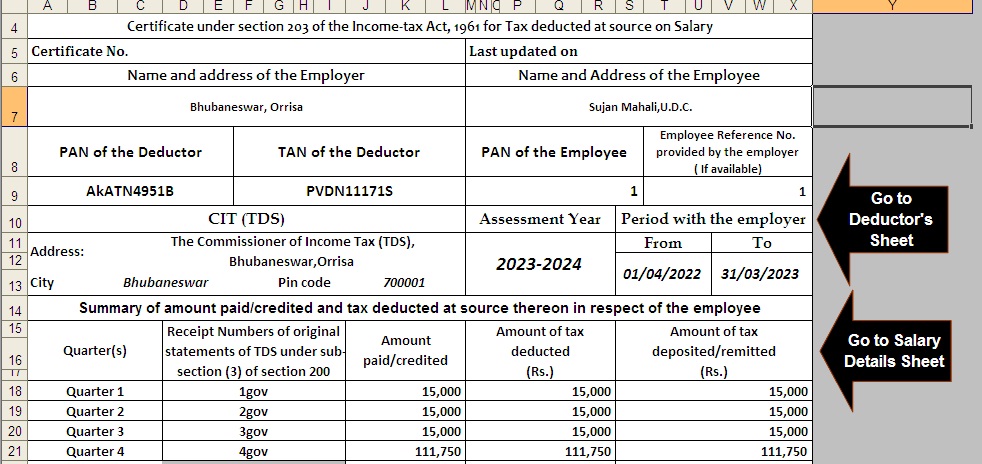
You may also like:- Master of Form 16 Part B for the Financial Year 2022-23 and Assessment Year 2023-24[This Excel Utility Can Prepare at a time 50 Employees Form 16 Part B’

Income Tax Preparation Software All in one


Income Tax Preparation Software All in one

Similarly, she added that a person with an income of Rs 15,000 would have to pay only Rs 1.5 lakhs or 10% of their income, which is a 20% reduction of the current liability of Rs 1,87,500./-


Raise the standard deduction


Salaried professionals say the new income tax rates for 2023-2024 are a boost for the middle class.


Changes to the standard deduction


The standard deduction benefit has been extended to employees and retirees, including family retirees, under the new tax system.


Salaried people will get a standard deduction of Rs 50,000 and pensioners Rs 15,000 under the proposal. Thus, all the wage earners with an income of Rs 15.5 lakhs or more will receive Rs 52,500 from the above proposals.


The top surcharge rate on personal income tax has been reduced from 37 % to 25% in the new tax regime for income above Rs 2 crore.


This will reduce the maximum personal income tax rate to 39%, which was previously 42.74%. The tax exemption limit on holiday pay at retirement for salaried non-government employees was increased from Rs 3,000 to Rs 25,000.


The new income tax system is a default tax system. However, taxpayers will still have the option to take advantage of the old tax system.


The new tax system does not provide any benefits that taxpayers can take advantage of in any section, including Section 80C - Tax Benefits of Previous Mortgage Loans


Download Automated Income Tax Preparation Excel-Based Software All in One for the Government & Non-Government (Private) Employees for the F.Y.2023-24 and A.Y.2024-25

Income Tax Preparation Software All in one
 
Income Tax Preparation Software All in one

Income Tax Form 16 Part A&B

Income Tax Form 10E

Feature of this Excel Utility:-


1) This Excel utility prepares and calculates your income tax as per the New Section 115 BAC (New and Old Tax Regime)


2) This Excel Utility has an option where you can choose your option as a New or Old Tax Regime


3) This Excel Utility has a unique Salary Structure for Government and Non-Government Employees Salary Structure.


4) Automated Income Tax Arrears Relief Calculator U/s 89(1) with Form 10E from the F.Y.2000-01 to F.Y.2023-24 (Update Version)


5) Automated Income Tax Revised Form 16 Part A&B for the F.Y.2023-24


6) Automated Income Tax Revised Form 16 Part B for the F.Y.2023-24

Monday, 13 March 2023

  Tax Calculator in Excel for Assessment Year 2024-25. As announced in the Union Budget 2023, the

 benefit of the standard deduction for taxpayers has been increased in the new regime. Self-employed

 people, pensioners, and family pensioners can now benefit from standard deductions under the new

 regime.


You may reduce your tax burden to claim deductions Under Section 80C. It allows deductions up to Rs 1.5 lakh for investments in various instruments like Public Provident Fund (PPF), Equity Lied Savings Scheme (ELSS), National Pension System (NPS), Tax-saving Fixed Deposits (FD), and others. Next to the common section to reduce your taxable income is through Section 80D Maximum of Rs. 25000/- for those below 60 Years of Age and Rs. 50,000/- for Senior Citizens.

You may also like:- Automated Income Tax Master of Form 16 Part A and B for the Financial Year 2022-23 and Assessment Year 2023-24[ This Excel Utility can prepare at a time 50 Employees Form 16 Part A&B]

Tax calculator in Excel for Assessment Year 2024-25

Under Section 16 of the Income Tax Act, of 1961, any salaried employee can take a standard deduction from his taxable income. No documentation or proof of investment needs to be submitted to claim it. Once retired, this standard deduction can also be used. You don’t need to get insurance or show proof of investment for it.


The government of India has changed the standard deduction from time to time to account for inflation. Currently, taxpayers can avail of a standard deduction of up to Rs 50,000. The biggest benefit of this is for those salaried employees who come in the category of taxable income only for a margin of Rs 50,000.


Previously, the conventional tax relief benefit was only available to those who opted for the old tax regime. However, after the Union Budget 2023, this benefit has also been extended to those who opt for the new tax system. Whichever tax regime you choose, you are entitled to a standard tax deduction of Rs 50,000.

Download Auto-calculate Income Tax Calculator in Excel for the Financial Year 2023-24 and Assessment Year 2024-25 as per Budget 2023

Main Data input sheet

Tax calculator in Excel for Assessment Year 2024-25

Friday, 10 March 2023

  Union Budget 2023 impact of income tax on salary deduction. With the presentation of the Union

 budget for 2023, expectations among the salaried category are increasing. The rising cost of living and

 rising inflation are already putting pressure on people's finances; now, recent layoffs in the tech sector

 have created even more cause for concern.


Budget 2023

As a result, more than 80 million taxpayers have had high hopes of a tax break through the government's higher standard deductions. This tax deduction is a flat deduction available to employees to achieve parity among different taxpayers.

You may also like: - One by One preparation Excel Based Income Tax Form 16 Part A&B and Part B for the F.Y.2022-23

Here's what's in the 2023 budget for income tax provisions and deductions.


The standard deduction in previous budgets


Historically, the standard payroll deduction was a significant tax advantage available to salaried employees for years before it was removed in 2005. However, in 2018, the payroll deduction was Rs. 40,000 was repaid, replacing the tax benefits available for transportation allowance (Rs. 19,200) and reimbursement of medical expenses (Rs. 15,000). Therefore, resulting in an additional tax deduction of Rs. 5800.


In addition to reducing employee tax liability, this measure had a positive impact on the 2018 budget with the goal of reducing paperwork and the compliance burden for employers. Again, in 2019, the tax threshold was increased to Rs. 50,000.

The impact of the 2023 budget on income tax

You may also like: - One by One preparation Excel Based IncomeTax Form 16 Part B for the F.Y.2022-23


This year's budget saw massive changes to the current income tax structure, including a reduction in the number of income brackets to 5 and changes to tax rates. Here you will find everything you need to know about the revisions to the income tax rules and their impact.

1. Deduction from salary under the new tax system


Under the new tax regime, the tax exemption limit is now Rs. 3 lakhs and the system will reduce the income slabs from six to five. As a result, retirees and now salaried employees will benefit from a standard deduction above Rs. 52,500 for taxable income above Rs. 15.5 lakhs.

You may also like: - Master of Form 16 Part B for the F.Y.2022-23 which can prepare at a time 50 Employees Form 16 Part B for the F.Y.2022-23 in Excel

Salary Structure

Union Budget 2023 impact of income tax on salary deduction

2. Increase the tax deduction limit


With the changes in the income tax system, the budget also proposed an increase in the tax deduction limit of Rs. 5 lakhs to Rs. 7 lakhs. This is good news for people whose income is less than Rs. 7 lakhs as all their income will now be tax-free regardless of the investments they make. So they no longer have to search for investment schemes to claim tax exemption.

Thus, it will help increase disposable income and give greater consumption power to the middle-income group.


3. Reconsider tax rates


In the Union Budget 2023, Finance Minister Nirmala Sitharaman announced the reduction of the top tax rate to 39% from the previous 42.74%. In addition, the Secretary of State also proposed reducing the maximum surcharge rate from 37% to 25% under the new tax system. In this way, the growth of individual contributors is further encouraged.

Download the Automated Income Tax Calculator in Excel for the Financial Year 2023-24 and Assessment Year 2024-25 as per Budget 2023

Union Budget 2023 impact of income tax on salary deduction


Thursday, 9 March 2023

  Six income tax exemptions allowed in the New Tax Regime as per Budget 2023 | The new tax system

 may have been introduced as a simpler, less burdensome alternative for taxpayers, but it is not

 necessarily without tax elimination.


Six income tax exemptions allows in the New Tax Regime as per Budget 2023

From the financial year 2023-2024, the new regime will become the standard tax system. That is, the rates and rules of this system will apply unless you explicitly choose the former regime, which offers various exemptions.

You may also like: - Automatic Income Tax Master of Form 16 Part B for the Financial Year 2022-23[ This Excel Utility can prepare at time 50 Employees Form 16 Part B]

However, before you make a final decision, you should also find out what tax exemptions you will be entitled to even under the new tax regime. Here are six such tax exemptions under the new regime (and the old regime, too).

Standard deduction of Rs 50,000


Introduced in the 2023 Budget to make the new regime more attractive to taxpayers, it is the most prominent tax benefit offered under the system. It is assigned by default; therefore you do not have to take any action or show evidence to be eligible to claim this deduction.


However, not all taxpayers are eligible. Like the old system, there are only salaried employees and pensioners. Entrepreneurs or self-employed individuals cannot enjoy this tax benefit. Family pensioners (who receive a pension after the death of the pensioner) are also entitled to the deduction.

You may also like: - Automatic Income Tax Master of Form 16 Part A&B for the Financial Year 2022-23[ This Excel Utility can prepare at a time 50 Employees Form 16 Part A&B]


Employer’s contribution to Employee’s NPS


This is one of the lesser-known tax benefits available under both regimes. While some tax deductions linked to the National Pension Scheme – Rs 1.5 lakh under section 80C or above and Rs 50,000 under 80CCD (1B) – have no place in the new regime, this deduction will be retained.


An employer’s contribution to the National Pension System (NPS) of up to 10% (14% of public servants) of the employee’s basic pay plus benefit for dependents is allowed as withholding under Section 80CCD(2). “Employer contributions are tax-free like rent and other expenses.

You may also like: - Automatic Income Tax Master of Form 16 Part B for the Financial Year 2022-23[ This Excel Utility can prepare at a time 100 Employees Form 16 Part B] 

Six income tax exemptions allows in the New Tax Regime as per Budget 2023

However, the tax-free limit for benefits received from employers has capped at Rs 7.5 lakh per annum. If the total amount of benefits exceeds this limit, the excess is treated as taxable employee benefits.


Existing employees can also renegotiate with their employers and HR to restructure their pay to enjoy this new financial year benefit.

Employer EPF contribution of up to 12% of the basic salary


The employer contributes 12 % of your basic salary to your employees’ provident fund (EPF) account. This amount too is exempt from tax provided the total retirement benefits you receive from your employer do not exceed the limit of Rs 7.5 lakh in a year.

Tax deduction on life insurance proceeds


Aside from gullible insurers who fall prey to questionable sales pitches, high-net-worth individuals often prefer life insurance policies with a linked unit, which value tax-free term returns as a major asset. This benefit is also present in both regimens.


However, there are some caveats if you buy policies bundled with an investment, such as linked unit insurance (ULIP) or endowment insurance.

You may also like: - Automatic Income Tax Master of Form 16 Part A&B for the Financial Year 2022-23[ This Excel Utility can prepare at a time 100 Employees Form 16 Part A&B]


Six income tax exemptions allows in the New Tax Regime as per Budget 2023

Six income tax exemptions allows in the New Tax Regime as per Budget 2023

From the financial year 2021-22, the government has introduced restrictions on the maturity yields of Ulips. So, if you pay total premiums above Rs 2.5 lakh for policies purchased after February 1, 2021, the term yield will be subject to tax. Budget 2023 added similar restrictions to traditional non-ULIP policies, especially endowment plans. If the total amount of premiums of such policies purchased after April 1, 2023, exceeds Rs 5 lakh, the income earned at the end of the term of office will be taxable.


In all cases, income received by designated family members upon the death of the insured is tax-free.


PPF or Sukanya Samriddhi Yojna maturity continues


You do not have to pay tax on the final income from investments in Public Provident Fund (PPF) and Sukanya Samriddhi Yojana. However, under the new regime, investments in these accounts are not eligible for section 80C deductions of up to Rs 1.5 lakh offered by the old regime.


Download the Income Tax Calculator in Excel for the Financial Year 2023-24 and Assessment Year 2024-25 as per Budget 2023[New and Old Tax Regime]

Six income tax exemptions allows in the New Tax Regime as per Budget 2023

Wednesday, 22 February 2023

 As a deduction, claim exemption less than Rs. 3.75 deficits and opt for the new tax regime - the Finance

Ministry calculates this by analyzing past tax collection data.

Old tax regime vs. new tax regime which is better for you


A few years ago, Finance Minister Nirmala Sitharaman introduced a new tax regime. But ordinary taxpayers were not showing much enthusiasm because the old tax structure had many tax exemptions. But this time, the finance minister tilted the new tax structure. He hopes this will encourage people to pay taxes in this way. Many calculations have already begun to determine how much money is earned in cash and what method of filing income tax returns is helpful. However, a senior Treasury official made the calculation to give to ordinary people. As it turns out, the fewer exemptions and deductions you have, the better it is to get a new tax structure.

You may also like:- Prepare at a time 50 Employees Form 16 Part B for the Financial Year 2022-23 And Assessment Year 2023-24

Old tax regime vs. new tax regime which is better for you

Income Tax Form 16 Part B

According to the budget proposal, those with an annual income of Rs 7 lakh will not have to pay tax under the new tax structure. However, this benefit is not available under the old tax system. A senior finance ministry official said the new tax structure will benefit those who claim a deduction of less than Rs 3.75 lakh while filing IT returns. According to Finance Ministry sources, this figure of 3.75 is not available after analyzing the data on tax collection. The official said they are confident that the majority of the people will ditch the old tax structure and adopt the new tax structure as fewer people will be able to show the Rs 3.75 lakh exemption in the investment, expenditure, and loan sectors.

You may also like:- Prepare at a time 50 Employees Form 16 Part A&B for the Financial Year 2022-23 And Assessment Year 2023-24

Old tax regime vs. new tax regime which is better for you


However, the Tax and Customs Administration is confident that the introduction of the new tax structure will reduce the risk for taxpayers, as they will not have to submit proof of tax deductions on their tax returns. Here, the tax can be paid at a flat rate after the standard deduction. Under the new policy, 5 percent tax will be levied between Rs 3-6 lakh, 10 percent between Rs 6-9 lakh, 15 percent between Rs 9-12 lakh, and 20 percent tax on its place of 12-15 lakh rupees. 30% tax on annual income above 15 lakhs. All this is done to gradually move people to the new tax structure. 

Note:- It will not be made mandatory under any circumstances, the Finance Minister also clarified.

Download and Calculate your Tax Burden as per the Budget 2023 for the Assessment Year 2024-25 in Excel as per the New and Old Tax Regime

Old tax regime vs. new tax regime which is better for you


Monday, 20 February 2023

  Download Form 16 for 50 employees, for the financial year 2022-23 and prepare it at the same time.

 This Excel utility can readily prepare Employee Form 50 16 Part B in the revised format for Fiscal

 Year 2022-23 and Assessment Year 2023-24


Download and Prepare at a time 50 Employees Automatic Income Tax Form 16 Part A&B for the Financial year 2022-23


Download Form 16

Download Form 16

Feature of this excel utility:-


1) This Excel utility can prepare 50 employees at a time, Form 16, Part B, according to the 2022-23 budget


2) This utility can be used by government and non-government concerned


3) Calculate your income tax automatically according to the New and Old Tax Regime


4) This excel utility contains all the income tax sections according to the Income Tax Act.


5) This excel utility can only be used as an excel file


6) This excel utility can be used by anyone and is easy to use.

Wednesday, 15 February 2023

   Download Automated Back Wage Exemption Calculator U/s 89(1) Income Tax With Form 10 E |

 Section 89 comes into force when the salary/annuity or other parts are paid sooner or later. As

 explained in Section 89, if you simply receive your salary in cash or in advance during the budget year

 because your total income for that year expands, increasing your taxable income will lock you in.

 Relief under Section 89. You must complete Framework 10E with these exact details and then submit it

 to your current principal to secure relief. The 10E structure must be filed online and you do not need to

 attach a duplicate to the tax return.


This is how the relief u/s 89 is determined


Step 1: Confirm the current year tax (calculation of completion and termination of education) on income by remembering back wages/advances/payments.


Step 2: Determine the tax for the current year (taking into account the suspension and suspension of education) on income, unless wages are less than money wages.

Step 3 – Step 1 is short for Step 2

Step 4: Confirm the fiscal year in which the salary will be received (cees and cessation of education account) on the income, remembering salary for arrears.

Step 5: Calculate the tax for the year during which wages/salary (counting educational interruption and educational interruption) must be received on income, excluding financially delinquent wages

Step 6: Step 4 Short Step 5

Stage 7: Exemption for late payment 89 = Stage 3 short Stage 6 (if positive, however, nil)

Step 8: Current Assessment Year for Tax Purchases = Step 1, Short Step 7

Download Automated Excel Based Income Tax Salary Arrears Relief Calculator U/s 89(1)with Form 10E from the Financial Year 2000-01 to the Financial Year 2022-23 (Updated Version)

Download U/s 89(1)
Download U/s 89(1)

Download U/s 89(1)

google.com, pub-7005347536103574, DIRECT, f08c47fec0942fa0